

Jaime Cochran
Ultra-Low Background Counting for LUX-ZEPLIN (LZ) Dark Matter Detector
Abstract:
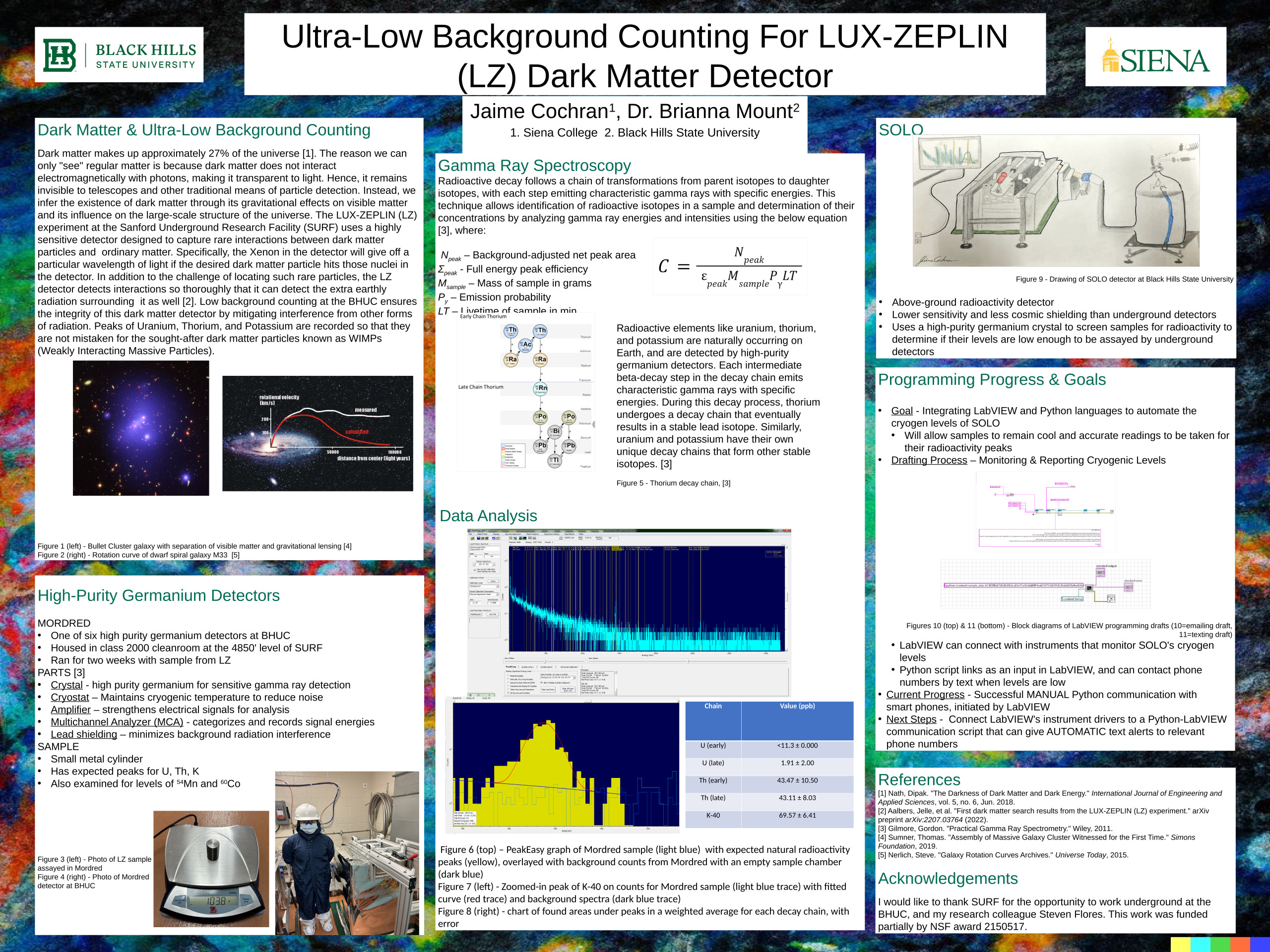
Dark matter makes up approximately 27% of the universe. The reason we can only “see” regular matter is because dark matter does not interact electromagnetically with photons, making it transparent to light. Hence, it remains invisible to telescopes and other traditional means of particle detection. Instead, we infer the existence of dark matter through its gravitational effects on visible matter and its influence on the large-scale structure of the universe. The LUX-ZEPLIN (LZ) experiment at the Sanford Underground Research Facility (SURF) uses a highly sensitive detector designed to capture rare interactions between dark matter particles and ordinary matter. Specifically, the xenon in the detector will give off a particular wavelength of light if the desired dark matter particle hits those nuclei in the detector. In addition to the challenge of locating rare particles, the LZ detector detects interactions so thoroughly that it can also detect the extra earthly radiation surrounding it. Low background counting at the BHUC ensures the integrity of this dark matter detector by mitigating interference from other forms of radiation. Peaks of uranium, thorium, and potassium are recorded so that they are not mistaken for the sought-after dark matter particles known as WIMPs (Weakly Interacting Massive Particles).Title
Ultra-Low Background Counting for LUX-ZEPLIN (LZ) Dark Matter Detector
Faculty Advisor
Dr. Brianna Mount (Black Hills State University)
Course
REU
Presentation Type
Poster
Location
Table 54