

Owen Spolyar
On the Persistence of Recurrent Epidemics
Abstract:
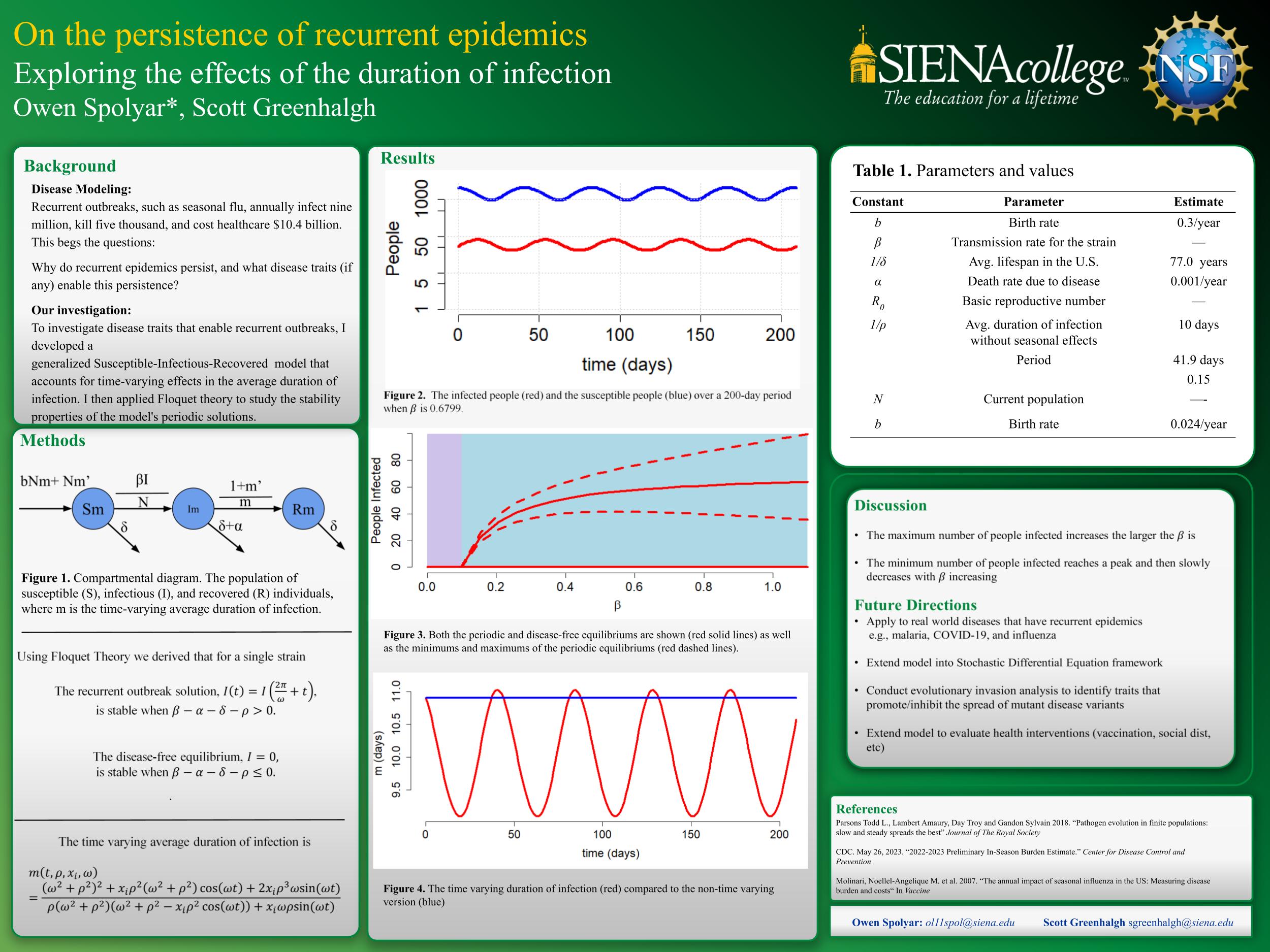
Recurrent disease outbreaks are commonplace in everyday society. For instance, every winter in the US novel variants of influenza arise, which infects millions of people, causing thousands of deaths, and creating financial hardship on the US healthcare system. In part, these hardships occur because novel variants of influenza feature genetic mutations that enable them to potentially evade individual immunity, and thereby spread throughout a population. While these new variants are detrimental to the health and well-being of the population, they may carry an unseen benefit. Namely, their spread may inhibit other, potentially more virulent, variants from propagating. However, insight on the relationship of the particular traits of variants that cause recurrent epidemics and the non-emergence of other highly virulent variants is limited. So, we develop a generalized Susceptible-Infectious-Recovered (gSIR) model, which can describe recurrent epidemics through its time-varying recovery rates, to inform on conditions that promote or prevent seasonal outbreaks. For our model, we determine the stability properties of all equilibria using the standard Jacobian approach, identify a potential periodic solution, and evaluate its stability properties using Floquet theory. We found the basic reproductive number by using the next generation method. Our findings show that the recurrent outbreak, namely the periodic solution, is locally stable provided that the basic reproductive number is greater than 0. By understanding the conditions that permit the formulation of recurrent outbreaks, health professionals can improve their capacity to make informed decisions on how to better combat future novel variants of disease.
Title
On the Persistence of Recurrent Epidemics
Faculty Advisor
Dr. Scott Greenhalgh
Course
CURCA/NSF
Presentation Type
Poster
Location
Table 29