

Natalie Colaizzo
Bioaccumulation of PFAS in Hudson River Fish
Abstract:
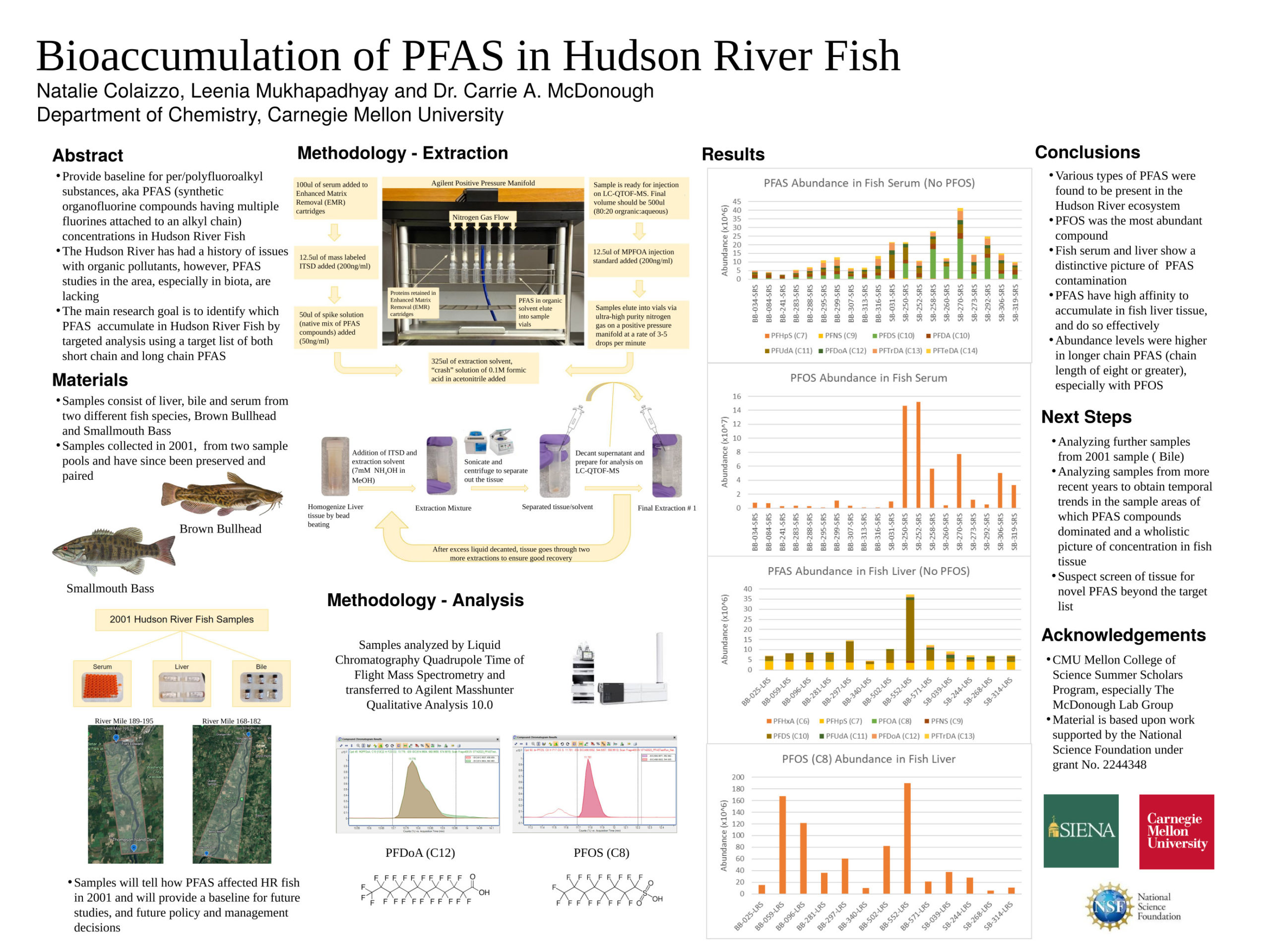
Per/polyfluoroalkyl substances (PFAS) are a class of anthropogenic, heavily fluorinated substances that are of rising concern. PFAS are persistent environmental contaminants, having polluted the environment since their creation for various consumer applications in the 1940’s; these compounds are highly bioaccumulative, making them an increasing risk for aquatic ecosystems, wildlife and humans. Exposure to PFAS is linked to many adverse health effects in humans such as immunosuppression, kidney and liver diseases and developmental impacts. The Hudson River has had issues with organic contaminants in the past, but PFAS studies in the area, especially in biota, are lacking. This project aims to investigate historical bioaccumulation patterns of PFAS in Hudson River fish over the years, starting with the early 2000’s, by measuring concentrations in fish fluid and tissue (serum, liver, bile) samples from two fish species (Smallmouth Bass, Brown Bullhead) to create a baseline dataset of early PFAS contamination in the area. Samples were analyzed with liquid chromatography quadrupole time of flight mass spectrometry (LC-QTOF-MS) via targeted analysis using a target list of both short and long chain PFAS, finding perfluorooctanesulfonate (PFOS), along with other longer chain PFASs (≥ C8) to be much more abundant than other short chain analogues.Title
Bioaccumulation of PFAS in Hudson River Fish
Faculty Advisor
Dr. Carrie McDonough (Carnegie Mellon University)
Course
SCDV 480 Internship in Science
Presentation Type
Poster
Location
Table 22